
Decoding the Language of Dentists
Every profession has its jargon — here's a plain-English guide to ours.
· Last updated
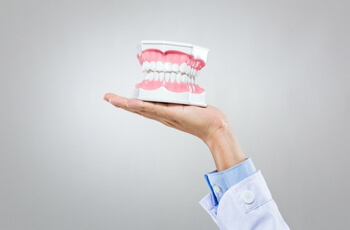
Every profession has its own vocabulary, and dentistry is no exception. We do our best to explain things in plain language, but sometimes the technical terms slip out. So here’s a handy glossary of words you may have heard us use, and what they actually mean.
Bookmark it for your next visit, it can make the whole conversation easier to follow.
Terms you might hear at a check-up
Abutment — a tooth on either side of a gap that supports a bridge, or a piece of metal or porcelain attached to an implant to hold a crown. Appliance — any removable dental restoration or orthodontic device, such as braces. Bitewing — a single X-ray showing the upper and lower teeth together, used to check for decay between teeth. Panoramic X-ray — an X-ray capturing all the teeth and the relationship between teeth, jaws and head.
Bruxism — grinding or clenching the teeth, often during sleep, which can stem from stress, misaligned teeth, or other factors. Malocclusion — a misalignment of the biting or chewing surfaces of the upper and lower teeth.
Terms about teeth and cleaning
Calculus — not the maths kind, but a hard, mineralised deposit on the teeth, often stained yellow or brown (see tartar). Plaque — a colourless, sticky film formed from food particles, saliva and bacteria, which hardens into tartar if neglected. Tartar — hardened plaque that sticks to teeth, creating a rough surface that attracts yet more plaque. Prophylaxis — the professional cleaning and polishing of teeth to remove plaque, calculus and stains.
Terms about treatments
Composite — a tooth-coloured mixture of plastic and fine glass or ceramic particles used for fillings. Restorations — replacements for lost or damaged teeth, such as fillings, crowns, bridges, dentures or implants. Veneer — a thin, custom-made shell of tooth-coloured porcelain or plastic bonded to the front of a tooth to improve its appearance. Lingual — the surface of a tooth that faces the tongue. Dry socket — a painful condition where the blood clot at an extraction site is dislodged, exposing bone or nerve.
Always ask
If we ever use a term that leaves you puzzled, please do ask, there’s no such thing as a silly question about your own care. And if it’s time for a check-up, get in touch with TMJ Therapy Centre to book a visit.
More on this topic: Sleep Apnoea & Snoring